The Akan Travel Journal · Côte d’Ivoire
Dances and masks of Côte d’Ivoire
Zaouli, Boloye, Goli and living traditions: discover the communities, stories and occasions behind the performances.
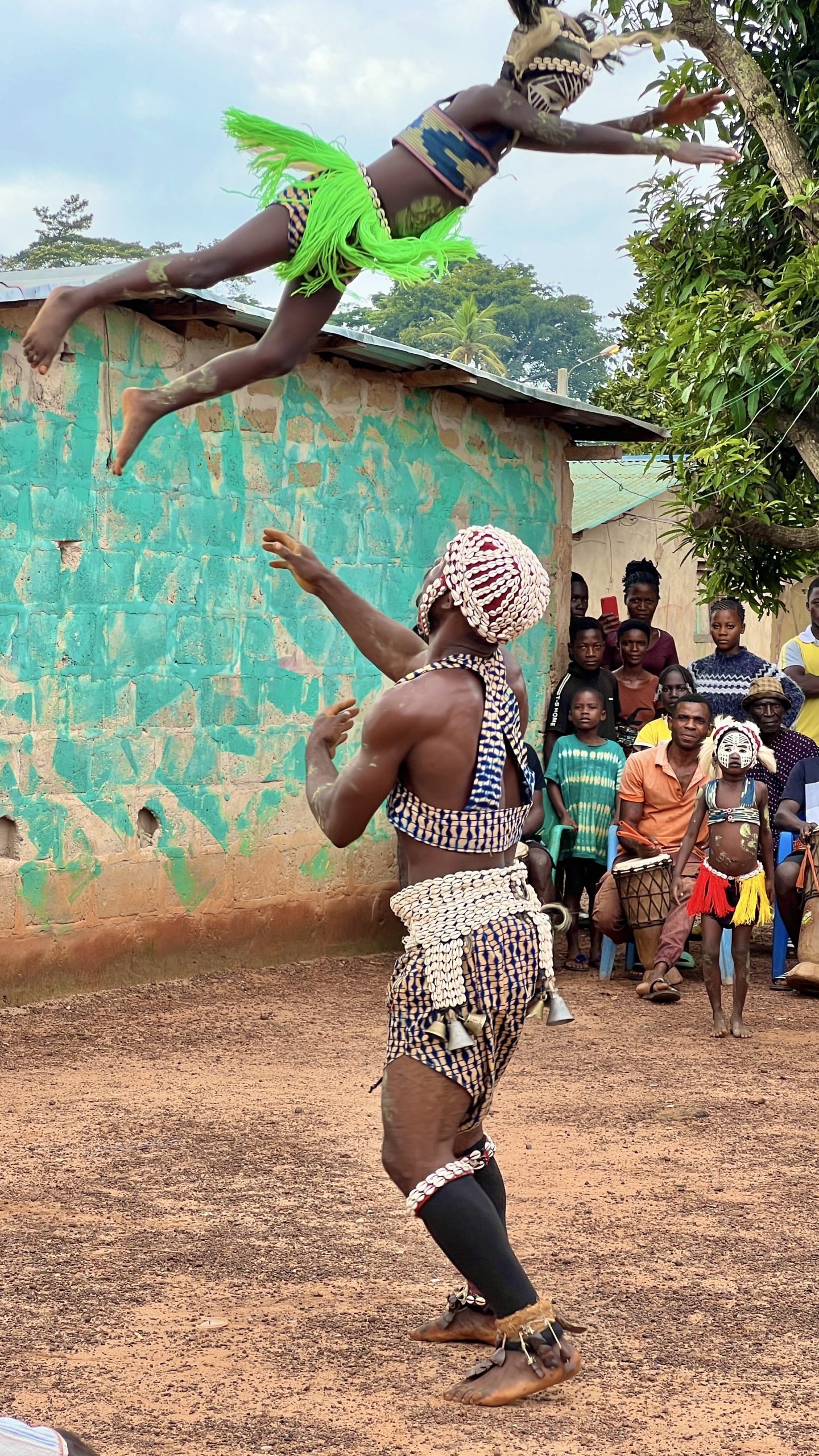
From the rapid rhythms of Zaouli to the panther dancers of the north and the masked stilt performers of the west, Côte d’Ivoire’s dances offer an extraordinary introduction to its cultural diversity. Each tradition belongs to particular communities, with its own stories, occasions and ways of welcoming an audience.
Understanding when a mask appears, who performs the dance and what the occasion means makes an encounter far richer. This guide explores six traditions, drawing on academic research, ethnographic archives and heritage institutions.
At a glance: dances, communities and occasions
| Tradition | Communities and region | Documented occasions |
|---|---|---|
| Zaouli | Gouro; central Côte d’Ivoire | Community gatherings, festivals and competitions |
| Boloye / panther dance | Fodonon, a Sénoufo subgroup; north | Funerals, celebrations and public presentations; links with Poro |
| “Snake girls” acrobatics | Documented among Dan and Guéré; west | The occasion and meaning need to be established with each performing group |
| Goli | Baoulé, adopted from Wan neighbours; centre | Funerals of important men and entertainment |
| Masked stilt dancing | Dan and Mahou; west | Locally determined public, festive or ceremonial settings |
| N’Goron | Sénoufo; Boundiali and other northern localities | Completion of a Poro cycle, celebrations and contemporary presentations |
A public presentation and a restricted ritual may involve related traditions while serving different purposes. There is no single national calendar for these encounters: the local community, the occasion and the hosts’ decisions matter.
1. Zaouli: beauty, rhythm and Gouro culture
Some dances make you want to follow the rhythm. Zaouli also makes you wonder how music, movement and craftsmanship can come together so completely. To appreciate it is to look beyond the dancer and discover the community behind the performance.
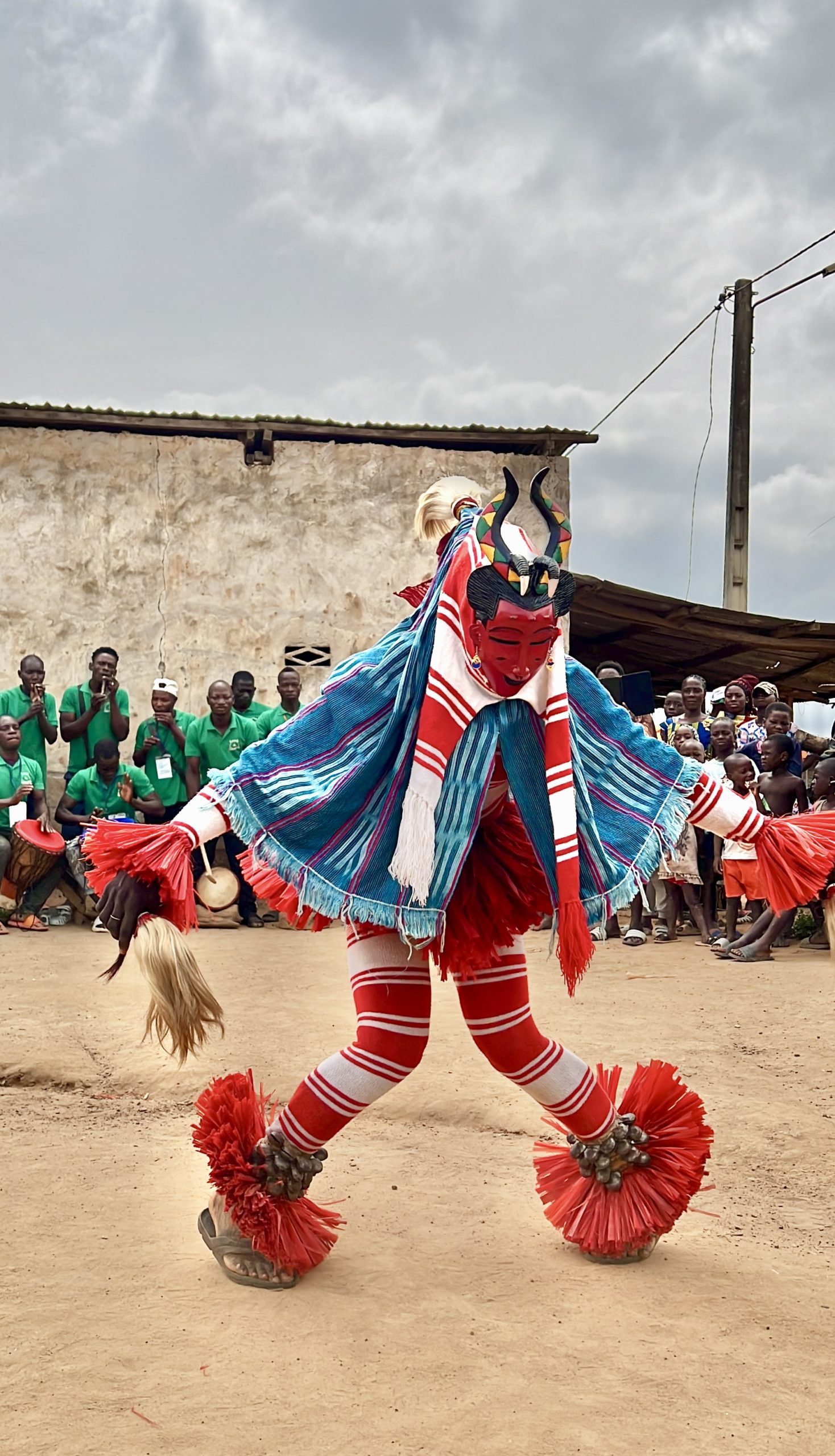
Where does Zaouli come from?
Zaouli belongs to the Gouro, also written Guro, communities, particularly in the departments of Bouaflé and Zuénoula, in central Côte d’Ivoire. UNESCO inscribed its music and dance on the Representative List of the Intangible Cultural Heritage of Humanity in 2017. [1]
When does the mask appear, and why?
Zaouli is performed at community gatherings, festivals and competitions between villages. UNESCO documents frequent local performances, rather than a tradition limited to one annual ceremony. These occasions bring people together through entertainment, learning and a shared sense of Gouro identity. [1]
What does it mean?
Zaouli honours feminine beauty. Its alternative name, Djela lou Zaouli, means “Zaouli, the daughter of Djela”. Seven types of facial masks are associated with particular stories. Sculpture, costume, song, music and dance form a single cultural expression: the carved face is only one part of the experience. [1]
The popular Zaouli performance also needs to be understood alongside the wider world of Gouro masks. Anthropologist Claudie Haxaire explores relationships between entertainment masks and more complex ritual ensembles. Similar names do not necessarily imply identical functions or meanings. [2]
Experience Zaouli with Akan Travel. Our local knowledge and contacts can help us arrange an encounter with Zaouli and the people who keep it alive. Knowing where to go, whom to speak to and how to understand the occasion adds something special to the experience. The magic lies in that connection: hearing the music, following the movement and discovering what the performance means to its hosts.
2. Boloye: the panther dancers of northern Côte d’Ivoire
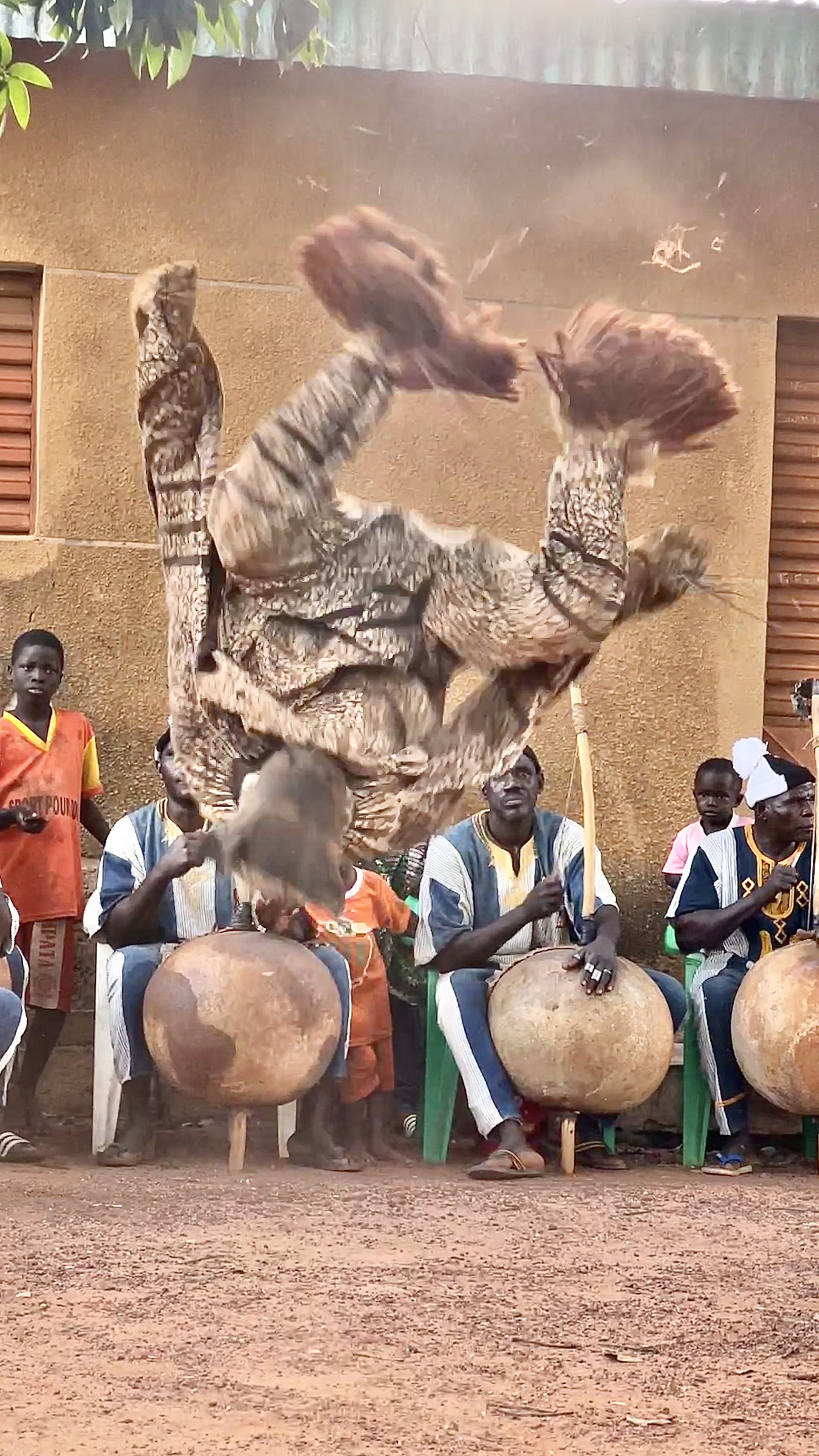
Spotted costumes and acrobatic movements explain the name many travellers remember: the dance of the panther men. Yet Boloye, also written Boloy, has a history that reaches far beyond its striking appearance. Boloye and the “panther dance” are names commonly used for the same tradition.
Which community practises Boloye?
Boloye is documented among the Fodonon or Fodonnon, a Sénoufo subgroup, in northern Côte d’Ivoire. A 2024 study by Simon Larsson and Syna Ouattara focused on a performing group in Waraniéné, near Korhogo. Research by Gnénébelougo Silué examines the tradition in Bré. These local accounts help explain its richness without assuming that every Sénoufo community follows the same practices. [3, 4]
When is it performed, and why?
Its history is connected with Poro and the sacred grove. Performances are documented at funerals and community celebrations, as well as public and tourism events. These settings can coexist, each with its own purpose and audience. [3, 4]
What does the panther represent?
The spotted costume explains the familiar “panther men” description. However, interpreting the whole performance simply as a symbol of animal strength would miss much of its meaning. Participants in the Waraniéné study described the music, singing, clothing and movements as recreating a performance originally witnessed among spirits in the forest. This is an oral account recorded by the researchers. [3]
In Bré, Silué highlights Boloye’s educational role and its contribution to community bonds. Even in a public setting, the dance retains connections with the transmission of knowledge. [4]
Discover Boloye with Akan Travel. With our knowledge of the region and our local contacts, we can help arrange an opportunity to experience Boloye and understand its setting. Take time to listen to the musicians as well as watch the dancers: together, they make the encounter memorable. Arrangements follow the hosts’ availability and the occasions they welcome visitors to share.
3. The “snake girls”: an acrobatic tradition of western Côte d’Ivoire
The name is intriguing, but it is only a starting point. The young acrobats often called “snake girls” are known for remarkable flexibility and coordinated movements. Understanding a particular performance means learning who its practitioners are and how they describe their own tradition.
Which communities are associated with it?
The Smithsonian’s film archives hold a 1968 film titled Acrobatic Dance of the “Snake Maidens”, catalogued as Guéré. Its description notes related practices among Dan and Guéré communities in western Côte d’Ivoire and eastern Liberia. [5]
Ethnomusicologist Hugo Zemp also documented dancers performing acrobatics with young girls in the Dan cultural setting, including the region around Man and Danané. [6]
When does it take place?
The documentation confirms a musical performance tradition, but does not establish one ceremonial calendar shared by all groups. The village, performing group and occasion provide the context needed to explain a particular presentation.
What does the name mean? Are masks involved?
The Smithsonian’s description connects the snake comparison with the way the young acrobats wind around their instructor’s body. That description alone does not establish a shared snake cult. [5]
Nor should the name lead us to assume that the girls wear masks. Acrobatics involving children, masked performances and dances involving live snakes need to be distinguished; Zemp mentions different practices in this region. [6]
Explore the traditions of the west with Akan Travel. Our local knowledge and contacts help us place encounters in their proper setting and seek explanations from the people who know the traditions firsthand. When an appropriate public performance is available, we can explore including it in your journey. The most meaningful moments often begin with a conversation that gives a name, a story and a human connection to what you see.
4. Goli: the many faces of a Baoulé mask performance
Goli is often spoken of as though it were a single mask. One of its most fascinating features, however, is the relationship between several characters and the order in which they appear.
Where does Goli come from?
Goli is well known among the Baoulé of central Côte d’Ivoire, who adopted it from their Wan neighbours. The Metropolitan Museum of Art dates that adoption to the first decade of the twentieth century. Its history is also a story of cultural exchange. [7]
When do the masks appear?
Goli may be performed at the funerals of important men, as well as for entertainment. The Smithsonian describes a full, day-long form involving four pairs of masks, organised through a hierarchy of younger and older, male and female characters. A shorter presentation may include only part of the ensemble. [8]
What do the characters mean?
The relationships between the masks are central to the performance. Their order of appearance and colours help express their identities, although colour and gender associations vary between villages. [8]
One character is Goli Glin, a senior male figure. The Metropolitan describes a headdress combining the head of a forest bovine with gazelle horns, worn with a costume of palm leaves. Its choreography is particularly vigorous and fast. [7]
Scholar Fernand Lafargue studied Baoulé Goli as encompassing supernatural power, ritual and an association. The word therefore carries meanings beyond the carved object itself. [9]
Encounter Goli with Akan Travel. Through our local contacts and knowledge of the area, we can help organise a Goli experience where a public presentation is available. Learning which characters are appearing and how they relate to one another brings the performance into focus. It is an opportunity to enjoy an extraordinary visual encounter while gaining a deeper understanding of its local setting.
5. Masks on stilts: balance and presence in western Côte d’Ivoire
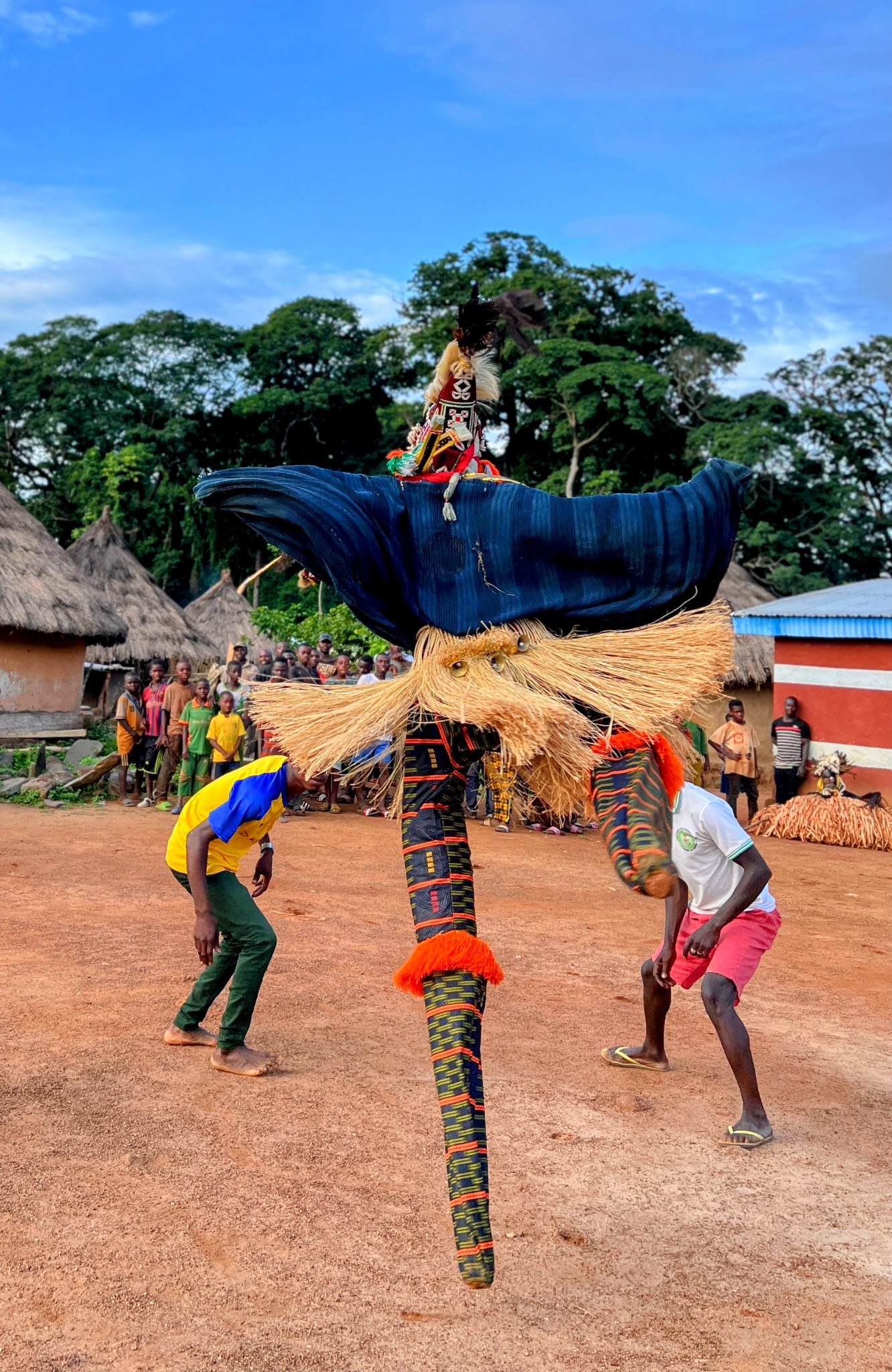
Height changes the way we experience a dance. As a masked performer moves above the gathering, balance, costume and rhythm transform the space around them. The impression can be unforgettable, especially when someone helps you understand the character you are watching.
Which communities practise stilt dancing?
Masked stilt dancing is documented among the Dan, also known as Yacouba, in western Côte d’Ivoire. Hugo Zemp mentions it in his ethnomusicological research. Official Ivorian educational material also associates stilt dances with Dan and Mahou communities, referring to Man and Touba. A photograph of stilts alone cannot establish the performer’s community. [6, 10]
When does the mask appear?
The occasion needs to be established locally. The sources used here do not support a single annual date, funeral function or initiation ceremony for every stilt performance. A public presentation, a festive gathering and an appearance connected with local ritual obligations each need their own explanation.
What does the mask mean?
As a broader context, the Metropolitan explains that certain Dan masks give visible form to forest spirits and participate in religious and political life. It also emphasises how difficult their functions can be to identify once they are removed from their performance setting. [11]
This helps explain their importance without assigning every stilt character the same spirit or role. Height and skill are visible; the character’s name, responsibilities and rules are matters of local knowledge.
Discover the west with Akan Travel. Our familiarity with the region and our local contacts can help us find opportunities to experience these performances and understand the occasion. We work around the hosts’ arrangements, allowing room for encounters that feel personal and memorable. Seeing the dancer is impressive; learning the story of that particular appearance gives the moment lasting meaning.
6. N’Goron: dance, generations and celebration in Boundiali
In Boundiali, N’Goron offers an introduction to the relationship between dance, learning and social recognition in Sénoufo life. Sometimes described to visitors as the dance of the “young virgins”, its story involves a much wider circle of participants.
Which community does N’Goron belong to?
N’Goron is a Sénoufo tradition, particularly associated with Boundiali and its surroundings in the Bagoué region. Ivorian educational documentation also places it in other northern localities. [10]
When is it performed, and why?
Mamadou Fofana’s research in Boundiali, undertaken in 2014–2015, connects the dance with the completion of a Poro initiation cycle. It describes a seven-year cycle involving periodic attendance in the sacred grove, followed by learning the dance. The celebration recognises the initiates’ efforts and their new position in the community. [12]
The same study documents performances at weddings, funerals, receptions and on contemporary stages. A visitor may therefore encounter N’Goron in several settings, each with its own significance. [12]
What does it mean, and why the reference to “virgins”?
N’Goron expresses belonging, learning and relationships between generations. Young men and women, musicians, traditional authorities and the audience all contribute. Fofana records virginity as a traditional condition of female participation in the context he studied. This should not be treated as a statement about any present-day dancer’s personal life. [12]
A Sénoufo cultural repertoire also describes local dance competitions and costumes decorated with cowrie shells. These variations are best understood in the communities where they occur. [13]
N’Goron is presented here as a collective dance, rather than a performance centred on one mask.
Experience Sénoufo culture with Akan Travel. Our knowledge of northern Côte d’Ivoire and our local contacts can help us organise a meaningful encounter with Sénoufo culture, including N’Goron when a suitable performance is available. Music, movement and the welcome of your hosts can turn a visit into something magical. We shape the experience around the local setting, giving you time to listen, understand and connect.
A more personal way to experience Côte d’Ivoire
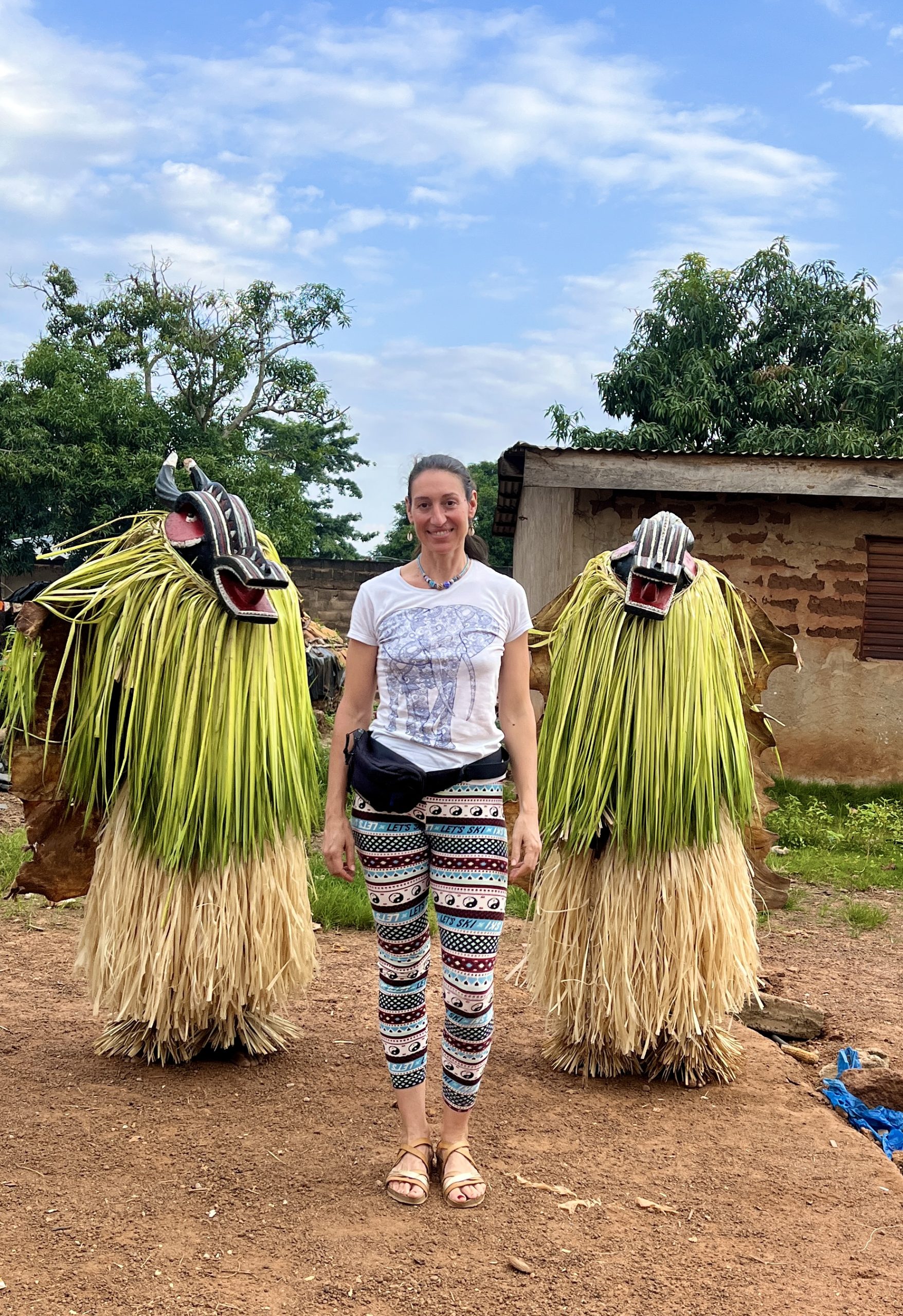
Our local knowledge and contacts help us organise authentic cultural encounters that can become the most magical memories of a journey. We take time to understand the setting, speak with the people involved and build a route around the experiences available during your visit.
Tell us which traditions interest you and when you would like to travel. We can explore suitable opportunities as part of a private journey or a longer cultural expedition. Specific performances depend on local availability and community arrangements.
Plan your cultural journey with Akan Travel → · Explore our Côte d’Ivoire expedition
Sources and further reading · 13 references
This guide draws on academic publications, a university dissertation, ethnographic archives, museum collections and heritage documentation. Historical accounts and local studies provide context; they are not universal descriptions of every present-day performance.
- UNESCO: Zaouli, popular music and dance of the Guro communities, nomination file 01255, inscribed in 2017.
- Claudie Haxaire: The Power of Ambiguity, Africa, online publication 2011. Academic abstract consulted.
- Simon Larsson and Syna Ouattara (2024): Taken from the Spirits and Given to the People: The Dance of the Panther Men in Côte d’Ivoire, Sustainability, 16(21), 9455. Indexed research extracts consulted.
- Gnénébelougo Silué (2024): La danse Boloye chez les Fodonnon de Bré, Forum de la Communication et des Arts, MASA proceedings, from p. 297.
- Smithsonian Human Studies Film Archives: Acrobatic Dance of the “Snake Maidens”, 1968. Indexed archive description consulted; film not viewed.
- Hugo Zemp (1964): Musiciens autochtones et griots malinké chez les Dan de Côte d’Ivoire, Cahiers d’études africaines, 4(15), pp. 370–382.
- The Metropolitan Museum of Art: Goli Glin helmet mask, object 1979.535.2.
- Smithsonian National Museum of African Art: Baoulé face mask, object 73-7-736.
- Fernand Lafargue (1971): L’Amwi Goli, Cahiers des religions africaines, 5(9), pp. 113–142. Bibliographic summary consulted.
- Côte d’Ivoire Ministry of National Education, DPFC: AEC training module, 2022.
- The Metropolitan Museum of Art: Dan face mask, collection entry 314700. General context for Dan masks.
- Mamadou Fofana (2014–2015): La dimension éducative d’une médiation culturelle : le N’Goron chez les Senoufo de Boundiali, master’s dissertation, especially Chapter IV.
- Senoufo.org: N’Goron, supplementary cultural repertoire.
Leave a Reply